
Erasmus+ Teaching Staff Mobility
The EU education program Erasmus+ has been promoting cross-border mobility of students and university academic and non-academic staff since 1987. In addition, diverse cooperation and partnership programs offer far-reaching opportunities for institutional exchange between universities in Europe and worldwide.
Teaching staff at TU Dortmund University can apply for an Erasmus+ mobility grant via the International Office. The prerequisite for teaching abroad is a valid Erasmus+ Inter-Institutional Agreement and consultation with the Erasmus+ Departmental Coordinator.
Well Informed
- Professors and lecturers with a contractual relationship with TU Dortmund University
- Adjunct lecturers at TU Dortmund University
- Research assistants at TU Dortmund University
- Doctoral students at TU Dortmund University who are involved in teaching
Program Countries:
27 Member States of the European Union (EU)
Belgium | Bulgaria | Denmark | Estonia | Finland | France | Greece | Ireland | Italy | Croatia | Latvia | Lithuania | Luxembourg | Malta | Netherlands | Austria | Poland | Portugal | Romania | Sweden | Slovakia | Slovenia | Spain | Czech Republic | Hungary | Cyprus
6 Countries outside the EU
Iceland | Liechtenstein | Northern Macedonia | Norway | Serbia | Turkey| United Kingdom
The partner countries are also clearly listed on the DAAD website. Here there is the possibility to apply for funds via Erasmus+ International Mobility in KA131.
United Kingdom
In the current Erasmus + program generation (2021-2027), the United Kingdom is eligible as a partner country. Due to the international opening of the funding line KA131, outgoing mobilities from Germany to the UK are eligible for both staff and students if TU Dortmund University receives sufficient funds in the corresponding Call.
From the 2027/2028 academic year, the United Kingdom will once again participate in the Erasmus+ program as a program country. Details regarding the return are still being clarified.
Switzerland
From the 2027/2028 academic year, Switzerland will also return to the Erasmus+ program as a program country. Details regarding the return are still being clarified.
Each department has Erasmus+ Inter-Institutional Agreements that contractually stipulate student and/or teaching staff mobilities. Therefore, only mobilities for which a corresponding Erasmus+ Inter-Institutional Agreement exists can be funded.
Erasmus+ partner universities (teaching staff mobility)
Erasmus+ partner universities (student mobility)*
*On the linked page you can see who is the Erasmus+ Departmental Coordinator in your department and find out about the opportunities for teaching staff.
Guest lecturers can strengthen the European dimension of the host university through their Erasmus+ mobility, complement its range of courses and impart their specialist knowledge to students who do not want to or cannot study abroad.
Further goals may be:
- Strengthen and develop links between departments
- Exchange of teaching content and methods
- Preparation of future cooperation projects
- Development of a joint study program
In general, the following conditions apply:
- Participants must belong to the specified group of individuals (see "Who Can Apply?")
- Only for teaching stays (not for conference participation)
- An Erasmus+ Inter-Institutional Agreement must exist for the relevant subject
- At least two consecutive days (excluding travel days) | maximum six weeks or the number of days agreed upon in the Inter-Institutional Agreement
- The stay must include at least eight hours of lessons in one week or shorter (at least two days)
- For each additional workday beyond one week (five workdays), the minimum number of hours per additional day is calculated as follows: eight hours divided by five days, multiplied by the number of additional days
- If teaching is combined with continuing education and professional development (Fort- und Weiterbildung), the teaching load is reduced to four hours per week
What happens if the Erasmus+ funds are not sufficient to cover all mobility activities?
The amount of Erasmus+ funding provided by the DAAD may vary from one call for proposals to another or from one academic year to the next. Therefore, there are not always sufficient funds available to support all requested mobility activities to the desired extent.
If the available funds are insufficient to finance all requested mobility activities, applications must be prioritized according to transparent criteria. The goal is to distribute the available funds as fairly as possible and to enable as many people as possible to participate in the Erasmus+ program. Staff mobility applications may still be submitted at any time.
If prioritization is necessary, the following aspects are taken into account in particular:
- Program country over partner country
- One staff mobility per person within a two-year period
- Funding history: Individuals who have not yet received Erasmus+ funding, or who have received it only rarely, will be given preference.
- Multiple staff members from the same department at the same host institution during the same period: In this case, one person’s mobility may be fully funded. For additional individuals, funding covering 50% of living and travel expenses may be available, depending on the funds available.
The criteria listed above do not mean that staff mobility can only be funded to the extent described. If sufficient Erasmus+ funds are available, a proposed mobility project may be funded in accordance with the individual’s eligibility for funding.
Erasmus+ funds are not a permanent source of funding (e.g., for conducting courses or modules at partner universities that are permanently incorporated into the curriculum each year).
Financial support is based on the different costs of living in the destination countries. Depending on the Erasmus+ project, different funding rates and options apply depending on the country group.
Accommodation Expenses
Depending on the group of countries, the following uniform daily rates apply until the 14th funding day:
- Group 1: 180 EUR
Austria, Belgium, Denmark, Germany, Finland, France, Ireland, Iceland, Italy, Leichtenstein, Luxembourg, Netherlands, Norway, Sweden, (Partner Country: United Kingdom) - Group 2: 160 EUR
Cyprus, Czech Republic, Estonia, Greece, Latvia, Malta, Portugal, Slovakia, Slovenia, Spain - Group 3: 140 EUR
Bulgaria, Croatia, Hungary, Lithuania, North Macedonia, Poland, Romania, Serbia, Turkey
from the 15th to the 60th day of support, the support amounts to 70 percent of the daily rate:
- Group 1: 126 EUR
Austria, Belgium, Denmark, Germany, Finland, France, Ireland, Iceland, Italy, Leichtenstein, Luxembourg, Netherlands, Norway, Sweden, (Partner Country: United Kingdom) - Group 2: 112 EUR
Cyprus, Czech Republic, Estonia, Greece, Latvia, Malta, Portugal, Slovakia, Slovenia, Spain - Group 3: 98 EUR
Bulgaria, Croatia, Hungary, Lithuania, North Macedonia, Poland, Romania, Serbia, Turkey
*Staff mobilities to the UK can still be funded as a partner country.
Travel allowances for outward and return journeys
In addition to the daily allowances, travel expenses will be reimbursed. The amount is based on the distance between the point of departure and the destination and is calculated using this Distance Calculator. The flat rates listed below apply per stay.
Also, individual support for sustainable travel is available as part of Green Travel. All participants who have a longer travel time due to the use of sustainable means of transport are eligible. In this case, up to four additional days can be funded as individual support.
Green Travel includes trips where low-emission means of transport such as trains, buses, or carpooling are used for the majority of the journey (more than 50% of the arrival and departure).
- 10 - 99 km: 28 EUR (for Green Travel: 56 EUR)
- 100 – 499 km: 211 EUR (for Green Travel: 285 EUR)
- 500 – 1,999 km: 309 EUR (for Green Travel: 417 EUR)
- 2,000 – 2,999 km: 395 EUR (for Green Travel: 535 EUR)
- 3,000 – 3,999 km: 580 EUR (for Green Travel: 785 EUR)
- 4,000 – 7,999 km: 1,188 EUR
- 8,000 km and more: 1,735 EUR
Additional funding for participants with disabilities or chronic illnesses
University staff with a degree of disability (GdB) of 20 or more, with a proven disability requiring additional financial support, or with a chronic illness are eligible to apply for funding to cover additional costs through the International Office (Andrea Schöne).
Additional funding for participants who are traveling abroad with children
University staff who receive Erasmus+ funding for a stay abroad and travel abroad with a child or children can apply to the International Office (Andrea Schöne) for support to cover the additional costs actually incurred (actual cost application).
Additional funds can be requested for recipients who are undertaking their mobility abroad with a child or children, provided that
- the child is a biological child, adopted child, or foster child, and
- the child/children is/are taken along for the entire duration of the stay abroad, and
- the child/children is/are under 18 years of age.
Important information
The Erasmus+ Mobility Grant covers accommodation and travel costs, which are subsidized by the EU Commission/DAAD as unit costs, as shown above. The grant recipient is obliged to pay tax on any positive differences between actual costs and unit costs.
No travel expenses will be reimbursed under the LRKG NRW.
Before the mobility
The planned teaching staff mobility must be applied for by e-mail through the International Office (Andrea Schöne) at least six weeks before the planned stay. Please state the planned working days abroad, date of arrival and departure, actual place of arrival and departure and name of the host university.
Once you have received confirmation that the mobility is eligible for Erasmus+ funding, please submit the following documents to Andrea Schöne:
- the Invitation from the host university,
- the Online Acceptance Form, the Mobility Agreement and submit
- a business travel request via SAP - you will receive the relevant information from the International Office / Andrea Schöne.
If all documents are complete, you will receive a Grant Agreement with the funding guidelines, which must be signed and returned to the International Office.
To ensure your mobility, Department 3.2 will automatically request an A1 Certificate/Secondment Certificate from your health insurance provider for France, Italy, Austria, (and Switzerland) after you have submitted your SAP business trip application. Otherwise, you are not required to carry an A1 Certificate/Secondment Certificate with you.
Before traveling abroad, special precautions must be taken, such as conducting a risk assessment, seeking travel medical advice, or, if necessary, getting vaccinations. Please contact the occupational health service of Office of Occupational Safety, Environmental and Health Protection well in advance.
Travel safety: The decision to travel to risk areas lies with you and TU Dortmund University, taking into account the regulations of the Erasmus+ program, the institution's internal strategies and the respective crisis management. This also means that you must inform yourself about the current situation in the host country on the website of the Federal Foreign Office and consult with the International Office before you begin your stay abroad.
Insurance Coverage: Participation in the Erasmus+ program does not automatically include any insurance coverage. Participants are responsible for ensuring they have adequate insurance coverage during their stay abroad (health insurance, liability insurance, accident insurance, etc.). Participants are responsible for obtaining insurance coverage on their own.
According to the information flyer from the Unfallkasse NRW, employees are generally covered by statutory accident insurance while performing official duties abroad. Activities in the private sphere are, of course, not covered by this.
Should a work-related accident occur, it must—as usual—also be reported to TU Dortmund University.
Further information from TU Dortmund University regarding international travel health insurance coverage (Auslandsreisekrankenversicherungsschutz) can be found in the ServicePortal under Business Trips.
During the mobility
Optain a Certificate of Attendance from the host institution at the end of the Erasmus+ mobility period.
After the mobility
- Send a copy of your travel receipts (flight/train + hotel) together with the Certificate of Attendance (original) to the International Office within two weeks of the end of the business trip.
- A link to the EU Online Survey will be sent to you directly by e-mail from the EU Commission.
Mobilities at selected partner universities in Erasmus+ partner countries are generally possible. Faculty members can apply for Erasmus+ mobility grants for the following academic year by March 31 of each year within the framework of existing departmental cooperation agreements. This program option is called Erasmus+ International Mobility.
Teaching Staff Mobilities in a partner country are only possible through the contact person in the department responsible for the relevant cooperation and who has submitted and received approval of an application for funds in International Mobility in KA131.
The administrative procedures differ very little from the administrative steps outlined here. However, it is important to note that some requirements—such as the minimum length of stay—differ for mobility to a partner country compared to mobility to a program country. Participants will be informed individually by the International Office about the procedures via email.
If you have any questions, please contact Silke Viol directly.
Testimonials
Alexander Wuttke, M.Sc.
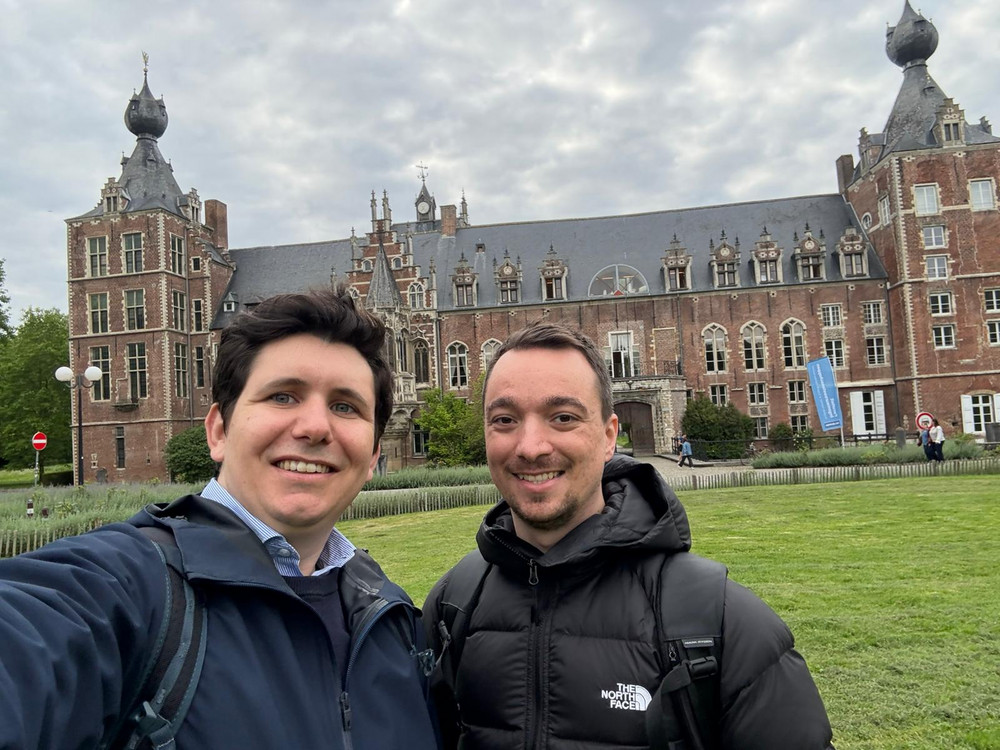
Research Assistant in the IT in Production and Logistics Department of the Department of Mechanical Engineering
In May 2026, as part of the Erasmus+ faculty exchange program, I had the opportunity to spend time at the Katholieke Universiteit (KU) Leuven in Belgium. The historic university town, with its impressive city center and vibrant student life, provided a particularly beautiful setting for this experience. During my stay, I was able to test a hands-on teaching approach in which students built and programmed a robot capable of grasping and transporting components using provided parts and microcontrollers.
In addition, they developed a digital twin for real-time monitoring and control. I also had the opportunity to give two guest lectures in different degree programs.
The professional exchange on teaching approaches and academic organization was very enriching for both sides. I am particularly pleased that parts of the tested teaching approach are to be continued in Leuven. Furthermore, the contacts made during the mobility period have also created opportunities for further academic collaboration. I found the support from both universities to be very positive. I can therefore highly recommend participating in the Erasmus+ faculty mobility program, both for personal development and for strengthening international collaborations.
Tobias Schmidt (Ph.D.)
Research Assistant and Ph.D. candidate at the Chair of Economic Policy Journalism at the Institute of Journalism, Department of Cultural Studies
In April 2026, I was fortunate enough to travel to Lisbon through the Erasmus+ Faculty Mobility Program. I taught at the Universidade Nova de Lisboa for two weeks and gained many wonderful experiences. In several courses, I spoke with both bachelor’s and master’s students about the fundamentals of modern language models—how they’re structured, what happens “under the hood,” which use cases they’re suitable for—and which ones they aren’t (yet).

I really enjoyed this experience. The exchange with my colleagues there was also very valuable: Over the course of two weeks, two small research projects took shape, on which we are now working across national borders.
In addition to the professional experiences, I brought back to Dortmund, above all, new motivation and inspiration for my own teaching and research. Working in a completely new place, with new people, away from my daily to-do list, was personally very enriching for me. I can’t recommend the faculty exchange program highly enough to everyone. Thanks to the great support from the International Office, making it happen is much easier than you might imagine beforehand.
Dr. Manuela Vida-Mannl
Temporary Academic Councillor at the Chair of Linguistics of English (Multilingualism) at the Department of Language, Literature and Culture of Faculty 15
In March 2025, I had the opportunity to teach for a week at the Erasmus+ partner university University of Central Lancashire Cyprus through the Erasmus+ Lecturer Mobility program. Thanks to the great cooperation of the staff of the International Office of TU Dortmund University, the Erasmus Officer of Faculty 15 and the university in Cyprus, I was able to
teach 4 multi-hour units on various topics in sociolinguistics. Getting to know my colleagues and Cypriot and international students on site was incredibly enjoyable and gave me the opportunity to adapt and develop my teaching.
During my mobility, I was not only able to have an excellent exchange with my Cypriot colleagues in terms of research and teaching; the great cooperation has also prompted us to develop an Erasmus+ mobility agreement for students, so that the partnership between TU Dortmund University and the University of Central Lancashire Cyprus continues to grow. The Erasmus+ Lecturer Mobility is an excellent opportunity to gain international experience and expand TU Dortmund University's international network and, thanks to the great support from our International Office, I can recommend every colleague to apply.
